Editorial
Alenka Fikfak: Editorial – Creativity Game 2025 Read more ...
Editor-in-charge / UL FAWhat if we turned the exploration of space into a game? What if we stepped away from our computers and spreadsheets and instead picked up a sheet of paper and a pencil, relying on our own eyes to observe and our ears to truly listen to cities, streets, parks, and buildings? The Creativity Game journal invites us to experiment through direct contact with our surroundings. In this approach, freehand drawings, fieldwork, and improvised research methods become more than techniques – they become ways of understanding space itself.
In a world flooded with digital models, GIS systems, and masses of data, the journal embraces a different approach: an exploration that dives into movement, drawings, and details, encouraging play with shapes, lines, and proportions. Every sketch, every note, and every observed spatial change reveals new insights – insights that algorithms alone can hardly capture.
The new issue of The Creativity Game journal once again encourages creative experimentation: how might drawing or field sketching become a way of learning, communicating, and designing? How can direct engagement with a city or a landscape spark innovative solutions for sustainability, mobility, accessibility, and quality of life?
The journal invites us to explore without boundaries, to connect theory and practice, and to bring together architecture, urbanism, and landscape pedagogy. The 2025 issue continues this approach, treating the journal as a kind of laboratory – one where we can experiment, ask questions, and explore: how can we experience, understand, and shape space – through our hands, our eyes, and our creative imagination? And yes, also with numbers and digital tools. It is precisely this mix – between what is imagined and what is created in the research-driven and artistic imagination of the spatial planner, whether architect, urbanist, or landscape architect – that makes this exploration so rich.
Space is not just a surface or a collection of data; it is play, exploration, interaction, and lived experience. The Creativity Game journal offers a space where this play can truly be experienced and created. We invite you to dive in and explore the innovations of 2025.
Discussion
Aleksander S. Ostan: Some impressions on the importance of architectural drawing: sketches from a faculty excursion through Italy Read more ...
University of Ljubljana, Faculty of Architecture, SloveniaThe Faculty of Architecture in Ljubljana has a long and respected tradition. This tradition is strongly connected to the work of two important professors and architects, Jože Plečnik and Edvard Ravnikar, while at the same time continuously evolving and adapting to new architectural approaches. Both men were outstanding architects – each in his own era and each with a distinct architectural language and form of expression. At the same time, they were also exceptional freehand draftsmen and artists.
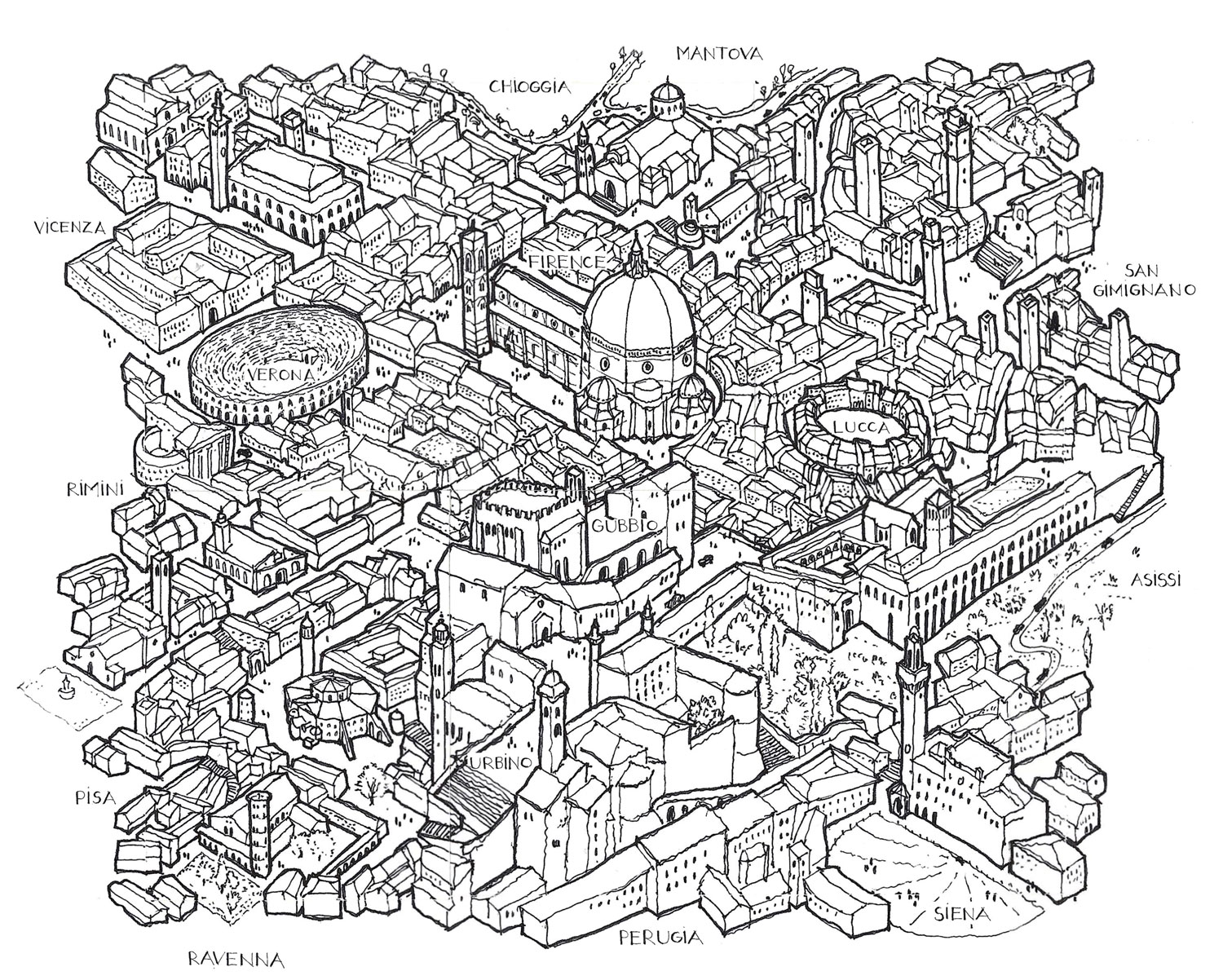 Author: Jan Šimnovec
The tradition of architectural drawing that was cultivated at the school and passed down from Plečnik to subsequent generations gained recognition throughout the broader European context. Architects trained at the Ljubljana School of Architecture were therefore highly regarded not only as artists but also as excellent draftsmen. This reputation was well known even in the Paris studio of Le Corbusier at 35 Rue de Sèvres. Among the nine Slovenians who worked in the atelier of Le Corbusier before the mid-twentieth century, Edvard Ravnikar stood out especially for his exceptional drawing skills. In recognition of this skill, Le Corbusier even allowed him – something very unusual in the studio – to leave his own signature on a drawing.
Sketching – as a distinct and perhaps the most immediate form of an architect’s expression – has always been an important part of the teaching tradition at the Ljubljana’s Faculty of Architecture. Study trips and excursions with a sketchbook in hand formed an essential component of architectural education for both masters, Jože Plečnik and Edvard Ravnikar, as well as for other professors at the school.
As the most outstanding student of the professor Otto Wagner, Plečnik was awarded a study trip to Italy in 1898–1899. Later, when he became a professor of architecture himself, he frequently travelled with his students on study excursions, particularly across Slovenia.
Plečnik’s foremost student, Ravnikar, later developed the concept of the so-called “Italian trips”. This tradition was subsequently continued for nearly thirty years by his assistant, and later professor, Marjan Ocvirk. Unfortunately, the tradition was interrupted for approximately twenty years. As times changed, drawing gradually lost some of its importance, while digital drawing increasingly became the principal tool used by both professors and students of architecture.
And yet we are increasingly aware that, in a time dominated by virtualization and artificial intelligence, the architect’s hand – what Juhani Pallasmaa famously described as the “thinking hand” – remains the most direct and sensitive instrument for expressing architectural perception and ideas.
This was precisely what we practiced again last year during the excursion to Italy. After many years, sketching once again became a daily activity. Along the way, we explored cities, squares, palaces, churches, and other sites, with each of us capturing them in our sketchbooks in our own unique way.
Papers
Tomaž Pipan, Neja Zalaznik:
Architectural landscapes and regions of Slovenia and contemporary urbanization: a selection of representative settlements
 Scientific Article
IU/CG, 13/2025, 22-29. https://doi.org/10.15292/IU-CG.2025.13.022-029
Scientific Article
IU/CG, 13/2025, 22-29. https://doi.org/10.15292/IU-CG.2025.13.022-029
Tim Gerdin:
The use of composite representations of space in history and today
Review Scientific Article
IU/CG, 13/2025, 30-36. https://doi.org/10.15292/IU-CG.2025.13.030-036
Domen Kušar:
Roof eaves as an integral part of the identity of the architectural landscape
Review Scientific Article
IU/CG, 13/2025, 38-43. https://doi.org/10.15292/IU-CG.2025.13.038-043
Aleš Švigelj, Marko Lazić:
Accessibility, safety and social inclusion of open public space
Review Scientific Article
IU/CG, 13/2025, 44-50. https://doi.org/10.15292/IU-CG.2025.13.044-050
Mara Vogrinec, Janez P. Grom, Matej Nikšič:
Urban density indicators in settlement densification and their testing on selected case studies
Scientific Article
IU/CG, 13/2025, 52-63. https://doi.org/10.15292/IU-CG.2025.13.052-063
Tomaž Berčič:
State of the Art of AI in Creative Industries in 2025:
The Birth of the Digital Overman
Professional Article
IU/CG, 13/2025, 64-69. https://doi.org/10.15292/IU-CG.2025.13.064-069
Short Scientific Articles
| Martina Zbašnik-Senegačnik, Alenka Fikfak: The impact of overheating on the morphology of the built environment of slovenian settlements and the health of users | UDK: 711.4:551.584.5:159.938.363.6 | stran 70-75 |
| Tomaž Berčič, Marko Stavrev: ENCLOD – enhancing governance capacities of local authorities using open data | UDK: 004.91:711.4 | stran 76-79 |
| Aleš Švigelj: Holistic lighting of open public spaces: an interdisciplinary research approach to the development of lighting guidelines | UDK: 712.25:628.9 | stran 80-83 |
| Tomaž Berčič, Sanela Pansinger: The Hubcities project: bridging spatial analysis and citizen science for the decarbonisation of airport and seaport territories | UDK: 711.4:502.131.1:004.91 | stran 84-89 |
Workshops and Presentations
| Use of Mycelium in Architecture: Experimental and Research Architectural Workshop | page 92-93 |
| ENCLOD Workshop: Open Data, Smart Cities, the Future | page 94-95 |
| International Week 2025 in Milan: Antifragility at Play – Exploring Antifragile Approaches in Urbanism, Planning, and Policies | page 96-97 |
| ENCLOD SMART CITY HACK 2025 – Data-Driven Urban Efficiency | page 98-99 |
| RCA 2025: Regional Contextualisation in Architecture: The Spirit of Place – Cultivating Identity In The Built Environment | page 102-103 |
| Settlement Densification: Solution or New Threat to the Quality of Living? | page 104-105 |
FULL VOLUME
PDF (10.00M) DOI: 10.15292/IU-CG.2025.13